Posts Tagged ‘Lightroom’
Lightroom 4 training course: Wednesday, 23rd May
Lightroom 4 course — Wednesday 23rd May, 2012
There are still a few places left on the one-day Lightroom training course we’re running next week. It’s being organised by and held at Four Corners, a centre of all things photographic. We get asked about group courses quite often but don’t often do them so if you’ve been waiting, now really is the time to come along!
In this one-day course, I’ll be covering a digital workflow using Lightroom 4 — bring your laptop and follow along with the examples, ask questions and take notes. We’ll be going over the setup of your catalogue, the organisation of your files, the import process, post-processing using the Develop module and exporting in different formats and colour spaces.
I’ll be demonstrating using Lightroom 4 but, for any Lightroom 3 users present, will cover areas where the two products differ. The one-day course costs £120 including VAT and is perfect for photographers considering Lightroom or already using it but not as well as they’d like. There’ll be lots of question-and-answer time, too.
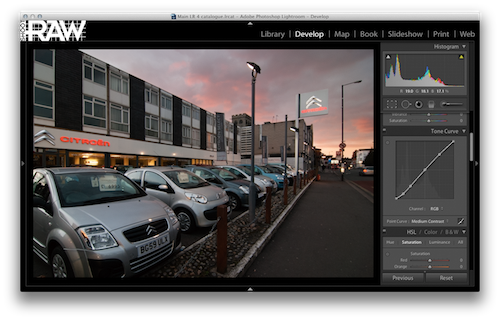
Above: the pink and yellow-orange highlights in this photograph, shot raw, are preserved in Lightroom 4 with no effort but are almost impossible to recover in Lightroom 3. Dealing with highlights and shadows is one of the topics we’ll be looking at when we cover the Develop module.
The booking form is over at the Four Corners Film site — to book your place, click here.
March 7th, 2012 by Bahi Para
Lightroom 4 is out
The results we saw in tests of Lightroom public beta were very positive so we’re pleased the final release follow so quickly.
Aside from soft proofing, which works very well, output quality for high-contrast images is up (retention of colour in highlights, in particular) and some odd bugs, like the use of local adjustments causing loss of highlight colour in areas that you weren’t painting on (!) have been quashed. It’s easier to get convincing and pleasing results in fewer steps. It’s also a great plus to be able to add noise reduction or colour-temperature changes to specific places.
Bug fix, Library module
You can now move many folders from one location to another at the same time by command-clicking (ctrl-clicking in Windows) to select the folders and then dragging any one of them (with the command or ctrl key released). In Lightroom 3, this functionality would silently fail — only one folder would be moved — and none of the point upgrades addressed it; in version 4, it works. It sounds like a small thing but we’ve often had to answer calls from photographers asking how to rearrange a folder structure in Lightroom and we’ve had to tell them to do it folder by folder.
Upgrading
The upgrade procedure from Lightroom 3 to 4 has been smooth for our machines and leaves a copy of your original LR 3 catalogue in place. Nevertheless, back up everything before you begin. As with the upgrade from Lightroom 2 to 3, you’ll see an exclamation mark next to an image that uses the older process version while in Develop mode. You can click that icon to update that image or all the images in the filmstrip. Resetting an image will also update the process version. Although LR 4 will make some attempt to preserve the look of an adjusted image when moving from process version 2010 to version 2012, you’ll likely have to tweak things to get them looking right — but the end result will likely be better than it was in LR 3.
Computer performance — check first
The new process version (2012) does place a heavy load on older hardware. If you’re running an old machine and a high-resolution camera, now might be a time to start looking for a new computer. If you’re unsure about your machine’s performance, download the trial version of Lightroom 4 first. It’s free to use for 30 days.
Price
Adobe’s new pricing is surprising but welcome: officially £86.57 excluding VAT for the full version and less than £50 ex-VAT for an upgrade. That’s roughly half of what you’d have paid for Lightroom 3 just six months ago.
Adobe Lightroom 4 from Amazon UK
Here are Amazon UK links for the full version and upgrade version of Adobe Photoshop Lightroom 4. There’s also a student and teacher version of Lightroom 4 here. (But remember that you need to show eligibility in order to get the student and teacher version running — without it, you won’t obtain a serial number.)
If you run the trial version first, you can buy a retail copy or buy from Adobe directly to convert your trial to the full version, without losing any work — you just need a serial number to activate the software after the 30 days are up.
Lightroom 4 training
If you’re a Lightroom 3 user interested in a top-up course to cover Lightroom 4 specifics or have been using Lightroom causally and would now like to use it in depth, please write or call (020 3092 2907).
We also have a Lightroom training day scheduled for photographers who are new to Lightroom or who haven’t yet got to grips with it — it’s a one-day course on Wednesday, 23rd May at Four Corners in London. It costs £100 plus VAT. Click here to book. (The training day was originally scheduled for 10th May but we moved it to avoid a date clash.)
February 20th, 2012 by Bahi Para
Lightroom training day coming. LR 4 beta out. Lightroom 3 on sale!
Topic 1: Lightroom training course, London, May 2012
Important update, April 2012: we’ve moved the date of this course by a week to avoid a date clash: it’s now scheduled for Wednesday, 23rd May 2012.
Every week, we get asked about Lightroom training courses for small groups. We now work mostly one-to-one with photographers but Helena and her colleagues at Four Corner are organising a one-day Lightroom course that I’ll be delivering on Wednesday 23rd May, 2012. I’ve taught at Four Corners before and it’s an excellent place; at £120 for the day, including VAT, this course is terrific value. I’ll set you up with a smooth, Lightroom-based workflow and answer your questions.
You’ll need to bring your own laptop running Lightroom 4 or Lightroom 3. You can use the 30-day trial of Lightroom if you’re still undecided. Questions? E-mail Helena or e-mail us.
Topic 2: Lightroom 4 beta released
It’s old news now but Lightroom 4 public beta 1 is available as a free, fully-functional download, valid till the retail release of Lightroom 4. Back when I last wrote about Lightroom’s closest competitor, Aperture 3, I said that Lightroom’s two weaknesses were the absence of soft proofing and the absence of a book-publishing package. This first public beta addresses both those issues and also makes some thoughtful changes to the Develop module, among other things.
A note of caution: Lightroom 4 public beta 1 is not yet ready for production use. It has lots of interesting new features and is good to experiment with but it’s no more than that. We’ll be talking about it on the course but unless it has been released officially by then, we’ll stick with Lightroom 3.
Key new feature: soft proofing in Lightroom 4
When you soft proof, you see your work on your computer’s monitor looking closer to the way it will look in print. That allows you to make adjustments specifically for the print version.
Above: image displayed in Lightroom 4 beta.
Below: unadjusted soft proof of same image (baryta paper and pigment ink)

Lightroom’s implementation of soft proofing is pretty much what we’d been hoping for: quick and simple, with useful histograms and warnings available. As soon as you start to adjust for the loss of contrast on a fine-art baryta paper, for example (compare the two images above), you get a clearly labelled virtual copy of the image for print, which you can safely delete at any time. For us, it’s easily more appealing than Photoshop CS 5′s equivalent — in Lightroom, the use of a paper-white background is practical and effective and it’s easier and quicker to switch between relative and perceptual conversions. (Not as tricky to understand as they might sound. Too long a topic to go into here — come to a training course!)
Topic 3: Lightroom 3 is discounted
Perhaps because of Lightroom 4 beta’s release or maybe because Aperture is now so affordable, the full retail copy of Lightroom 3 has been reduced to just £95 including VAT and delivery from Amazon. That is at least £100 less than the old street price. Click here to buy from Amazon UK.
Hoping to write again in days rather than months. Please call or write if you have questions.
October 27th, 2010 by Bahi Para
New training space in central London (and hello to readers of the BJP newsletter)
Training in central London
We’re often asked about Lightroom tuition in central London, rather than at photographers’ own studios, homes or offices. We’re pleased to say that we can now offer exactly that — an afternoon or a day in the very vibrant area around the Old Spitalfields market. It’s very easy to get to — it’s near Liverpool Street Station or Shoreditch High Street stations. Training will be at one of the meeting rooms at The Cube.
It’s ideal for Q & A, to go over aspects of your Lightroom-based workflow that you’re unsure of or for a full day’s training. You can bring a laptop with your work on it or we can just use ours. Call 020 3092 2907 for details or, better still, complete our contact form. To get to the form, just click here.
Coming up
We’re taking bookings for training in November and December (obviously!), there’s a complete website refresh coming up, we’re going to offer printer profiling soon for your printer/ink combinations and there are new workflow articles on the way.
Hello to readers of the BJP newsletter
If you’ve arrived here after clicking on a banner ad in the current BJP newsletter and you’re interested in help with your photographic workflow — working faster, getting better results — we’d love to hear from you. Call 020 3092 2907 or complete our contact form by clicking here.
Vision 10
We’ll have a discount voucher appearing in the show guide for Vision 10 on Friday, November 19th. It will offer a discounted rate for one-on-on Lightroom training. Look out for it!
September 23rd, 2010 by Bahi Para
Lightroom training course, Central London, 18th and 19th October
Last updated: Monday, 27th September: booking page is now live.
We’re really pleased to be able to offer you training in central London, at last! We’ve had lots of requests for more affordable training and we’ve now found a solution we’re delighted with.
We’re bringing to this group training course everything we’ve learned from our successful one-on-one workflow tuition about what photographers find easy and what they find difficult, so we know what to spend a little more time on.
We’ll keep updating this post with more details.
Where
The training sessions will be held at the seminar room at Jacobs, the famous photographic retailer, on New Oxford Street. They’ll run from 10am to 5:30pm with a break for lunch and short mid-morning and mid-afternoon breaks as well.
Affordable and flexible
The training costs just £70 per person per day, including VAT. This really is fantastic value for a small group course. (Maximum twelve attendees.)
We’ve done everything possible to keep costs low so there are no frills. We’re not training in a computer room so you won’t be needing your laptop—just bring along a pen and notebook (the type with paper in it, not a CPU, Intel or otherwise). The cost covers just the cost of the course.
You’ll definitely get more out of the training if you can make it to both days. On the second day, the format will allow question-and-answer time and recap but we’ll also go on to cover more advanced topics; that approach always helps the learning process. However, you’ll be able to book just the first day or (if you just need some questions answered and a little help with more advanced topics) just day two. Again, we’re keeping things as flexible as possible.
Day one: Introduction and complete overview of a Lightroom 3 workflow, Monday 18th October 2010
This day will leave you feeling well informed about the complete workflow and about what Lightroom 3 can do for you. Many of the photographers we’ve trained over the last year have been wary of at least one aspect or another—this first day of training is where you leave behind that uncertainty and learn the power of every part of the application; it builds knowledge and confidence. Setup, preferences, importing, filing strategy, keywording, collections, development, filtering, export for web, printing… this day will be a thorough introduction to a workflow based on Lightroom 3.
Cost: £70 including VAT.
Day two: intermediate and advanced Lightroom 3 tuition/Q&A, Tuesday 19th October 2010
More detail on day two and a more open format, with lots more time for questions. We’ll be looking at some essential third-party plugins and providing recommendations, we’ll go into detail about the various ways in which you can combine your Lightroom workflow with Photoshop and we’ll talk about creating your own presets to speed up every aspect of your Lightroom workflow (import, development, local adjustments and export). We’ll cover local corrections in more depth. You and the other attendees will lead the Q & A. Again, check back later for details.
Cost: £70 including VAT.
Get all your Lightroom questions ready and bring them with you on Tuesday—you’ll get plenty of time to ask them and get them answered in detail.
Payment
You can able to pay with PayPal (which accepts credit cards, if you have no PayPal account) or by bank transfer (contact us for details) or by cheque. You willll get a full VAT invoice.
Transport and location
There could hardly be an easier London location to get to. Jacobs is in the West End, near Tottenham Court Road tube station (Central and Northern lines) and close to Oxford Circus (Victoria and Central lines) in an area served by many bus routes. You can plan the London part of your journey by clicking here to get to TfL’s Journey Planner. (The link will set things up correctly for Jacobs, New Oxford Street, as your destination. Just enter your starting station or post code.)
Jacobs
Big photographic retailer in London with an excellent reputation and keen prices. The course will be held downstairs in the seminar room in the Professional Services department. Jacobs have been very accommodating in our dealings with them and we can highly recommend them. You’ll find an excellent stock of cameras and lenses (new and used) and a wide range of accessories at very keen prices.
How to book
Just visit the booking page here.
Pass it on
If you know people who might be interested in this offer, please pass on our details and tell them to check later in the week.
Questions?
Fire away—send e-mail, leave a comment or give us a call: 020 3092 2907.
Updates
For updates, check back here or subscribe to the blog by e-mail or RSS/Atom.
September 3rd, 2010 by Bahi Para
Colour in h.264 slideshows created by Lightroom 3
This article is about a Lightroom 3 quirk we’ve recently become aware of: a colour shift when exporting slideshows as self-contained movies for use iPhone, iPad, YouTube and Facebook. We see the problem on all our Macs; we haven’t tested yet on Windows.
Summary of the issue
Playing back self-contained slideshow movies that you create using Lightroom 3 might show significant colour shifts if you export at 720p or 1080p. (Tests done on Mac OS X 10.6.4 and Lightroom 3.2.) Update: a 720×480 movie also shows the issue, and I’ve updated the example zip file to include a sample at this resolution.
Background
We do post-processing work for weddings shot by a local professional and, as part of the package of print-ready and screen-ready images we produce for him, we now include two movie slideshows with soundtracks. (Good for wedding gusts to have a chuckle over.) The smaller slideshow movie (480 pixels) is for use on an older iPhone or Android device and the bigger one (at 720p HD) is for upload to Facebook or YouTube, or for use on an iPhone 4 or iPad. Both movies use the h.264 codec, which allows excellent compression and relatively small file sizes.
Colour shift at 720p and 1080p
What we’ve noticed is that the colour palette displayed in movies exported from Lightroom 3 varies with movie resolution and is not consistent when played back in different players; in particular, the 720p and 1080p sizes, coming straight from Lightroom 3, display different colours from the other sizes. (Other resolutions show some subtle colour shifts but their colours are still acceptable and are consistent across sizes. Not so for 720p and 1080p.)
Here are are some screen shots from two example slideshows, with a gaudy background colour wash, chosen so that you can see the affect on both warm and cool tones.
Above: a screen shot of a 480-pixel movie slideshow playing.
Below: a screen shot of 720p slideshow. Resolution aside, no differences in the settings between the two. Compare the colour of the blue MINI in the two pictures above and below.
Finally, below is the picture exported from Lightroom 3 as a JPEG in sRGB colour space, to act as a comparison against both movie screen shots. You can see that the 480-pixel shot is closer to displaying accurate colour.
When we originally saw the phenomenon, we were using Lightroom 3.0; the screen shots above are from the Mac version of Lightroom 3.2. The player was Apple’s QuickTime Player X.
Different results when movies are played in VLC or QuickTime Player 7
If you use VLC (free for the Mac, Windows and Linux) or QuickTime Player 7, colour is at least consistent across all movie sizes but is consistently wrong—VLC 1.1.3 (current version as of August 2010) and QTP 7 running on Mac OS X 10.6.4 appear to be ignoring the display’s ICC profile (ColorSync profile).
Download examples of h.264 slideshows from Lightroom 3
Here’s a seven-megabyte zip file containing a single-image slideshow at different movie resolutions, together with a 960-pixel JPEG of the same image in the sRGB colour space, for comparison. All the movie files came directly from Lightroom 3.2, with no change of settings between exports other than output resolution. You might notice that the colour in the 720p and 1080p versions are different from the rest.
AVC vs h.264
In QuickTime Player X, the 720p and 1080p clips also list “AVC” instead of “h.264″ as the codec used; in theory, h.264 and AVC should be identical so it’s not clear whether different code is actually used by Lightroom 3 to generate these two HD resolutions or whether QuickTime Player just identifies the same codec differently at these particular resolutions. In other words, this particular point could just be a client issue. QuickTime Player 7 lists all the movies’ codecs as being AVC and get the colour wrong on all of them, too.
The importance of your display profile (ICC/ColorSync)
Our tests suggest that your display profile will make a big difference in determining whether you see these colour shifts or not. The further it is from a regular, canned sRGB or “Color LCD” profile, the more difference you’ll see between the two AVC files (720p and 1080p) and the rest. Switch to a custom profile generated with a colorimeter or spectrophotometer and there’s a good chance you’ll see a bigger difference. (If you want see a huge difference between the two AVC files and the rest, set your display’s profile to “Wide-gamut RGB”.)
Preliminary advice on h.264 movie slideshows from Lightroom
We’re reporting the issue to gather feedback and direct it to the right place. We don’t have any definite answers (we don’t even know whether the problem is definitely a Lightroom issue or an OS issue) but here are some suggestions.
- Test your own h.264 slideshow output from Lightroom 3 at different sizes to see if you experience the problem and if you do, decide whether it’s a show-stopper. (It may not be—our example is likely to show a worse problem than most real-life files.) Compare your own results with our zip file of examples.
- Be aware that your clients who use different movie players might see different results from you when you provide h.264 output at 720p or 1080p. The differences will probably most important for product photography, portraiture and fashion. Colour in slideshows with music isn’t usually quite as critical as it is with files you submit to a stock agency or an art editor so this may not be a huge problem. If your results vary from ours, please report your findings on the Adobe Lightroom support forum, where I’ve just started a new thread about this problem. If you report the issue, provide as much information about your environment as you can (hardware, OS version, Lightroom version, display profile, details of media player).
- We only see the problem in 720p and 1080p slideshow exports from Lightroom 3. One workaround for now is to stick to 480-pixel or 960-pixel output. That way, when it’s played on another colour-managed computer in QuickTime Player, its colour will stand a better chance of being acceptable.
If and when we find out more, we’ll post something. This problem may be something to do with Lightroom, Mac OS X components, Quicktime Player or, erm, user error. More to come on this if we get something interesting for you.
The metadata
You can subscribe to these articles for free by e-mail (managed by Google) or by RSS/Atom. We never pass on your details to anyone. If you’re interested in technical training or help, please consider using our contact form to get in touch. You can also support this site by shopping at amazon.co.uk using this link or amazon.com using this link. (You pay the same low Amazon price but we get a bit from Amazon’s profit.) Thanks to everyone who uses this link… we don’t get to see your names in the Amazon reports so we don’t know who you are but we’re very grateful for your support.
September 3rd, 2010 by Bahi Para
Controlling JPEG file sizes in Lightroom 3
Summary: file sizes of low-resolution JPEGs that you export using Lightroom can be excessive if you don’t take steps to control the embedded metadata. The large file sizes can affect your site’s loading speed and that in turn can now affect your Google search rank.
re-photo.co.uk
Earlier this week, I was catching up on some well written and informative articles by London photographer and writer Peter Marshall when I came across this one mentioning the release of Lightroom 3.2RC; in the piece, Peter mentioned that he’d found Lightroom 3 to be generating relatively low quality JPEG files for a given file size, at the 600-pixel dimensions that he uses for his site.
Peter had noticed two significant things: first, that he was getting better JPEGs at any given file size when he created them using Lightroom’s web module (which is designed to export a complete web site) instead of the usual JPEG export method; second, that the problem was worse when he was exporting JPEGs of images for which he’d made use of Lightroom’s local adjustments, meaning brushes and graduated filters.
It turned out (see his follow-up post here, and the comments that follow it) that the metadata associated with the file was causing the bump in file size. Clicking “Minimize Embedded Metadata” when exporting JPEGs helps; installing a copy of Jeffrey Friedl’s Metadata Wrangler plugin for Lightroom 3 fixes the problem completely and has added benefits: you can set up presets that get saved with Lightroom’s own export presets. That means you can build a one-click Lightroom export preset that generates the right picture size for your site with all but the unimportant metadata removed, and just the important stuff retained. (Presets are the key to working quickly within Lightroom and are probably its most overlooked feature.)
Above: the checkbox used during export to minimise metadata. Not as effective as Jeffrey’s Metadata Wrangler.
Explanation: all local brush and graduated filter adjustments that you apply in Lightroom become part of an images’s metadata and are included on export, bumping up the size of the final JPEG file—particularly noticeable for small JPEGs, because this metadata size is a constant and can easily double the size of a file. Not a huge problem if you’re hosting one or two images on a page but if you’re putting up many, the extra file size is significant. For blogs that have the usual rolling front page, hosting all images from the last ten or twenty posts, this sort of thing can make a big difference for your visitors… and for Google.
Important for your photography site’s Google rank
These days, your site’s Google rank is partly dependent on the speed at which your site loads—see this important article from Google on the subject. It’s well worth doing what Peter is doing, optimising carefully and minimising JPEG image size. (On which note, if you’re using WordPress software and your own hosting account to manage your site’s content, you should make every attempt to install and enable WP Super Cache to speed up your site’s response under load. This isn’t the appropriate place to discuss the technical aspects of that plugin but it does its job very well. Obviously, make complete site backups first.)

Above: JPEG file sizes before and after reducing metadata in different ways. No affect on image quality.
Photo forum
As Peter mentions, we met at a monthly London event called Photo Forum where photographers (mostly photojournalists) show and discuss their work. The two of us here at Shoot Raw have been three or four times and always enjoyed it. It’s a busy event but a good way to see work that might be new to you and to meet other photographers, established and upcoming. (At the time of writing, the next event is on 9th September 2010.) It’s a credit to Jacobs Professional Services that they host the event every month.
Friedl on JPEG quality versus size in Lightroom
Jeffrey’s definitive article on Lightroom 3′s JPEG quality made the rounds a while back. If you haven’t read it and you generate JPEGs from Lightroom, pay a visit. It’s the last word on Lightroom 3′s JPEG quality versus file size and even those of us who thought we knew exactly what Lightroom was doing in this area learned a few things.
The metadata
You can subscribe to these articles for free by e-mail (managed by Google) or by RSS/Atom. We never pass on your details to anyone. If you’re interested in technical training or help, please consider using our contact form to get in touch. You can also support this site by shopping at amazon.co.uk using this link or amazon.com using this link. (You pay the same low Amazon price but we get a bit from Amazon’s profit.) Thanks to everyone who uses this link… we don’t get to see your names in the Amazon reports so we don’t know who you are but we’re very grateful for your support.
August 11th, 2010 by Bahi Para
Alternatives to personal Lightroom tuition
We often get enquiries about a less costly alternative to our one-on-one Lightroom training courses. Here are some ideas.
1) George Jardine’s Lightroom 3 workflow video tutorial for $29.95
Back when Lightroom was new, George Jardine produced an excellent podcast of related interviews and discussions that offered great insight into the product and some very useful video tutorials from George himself. The podcast also involved the Lightroom team, world class photographers and master printers who used the product and who were involved with its development.
George’s new video tutorial for Lightroom 3 doesn’t cover the Develop module—this one is all about workflow. The reviews are really good and, having listened to and enjoyed every single episode of that early Lightroom podcast back at the time of the first public betas and Lightroom 1, we can highly recommend George’s knowledge and his approach. Take a look at the free sample video and see what you think of his style. Some important notes: you can only watch these videos online (you don’t download them), there are separate links for the iOS versions (iPad/iPhone/iPod Touch) and you’ll need to make sure you’re up-to-date with your Flash browser plugin for Windows or the Mac.
(We are not associated with George Jardine.)
2) The Luminous Landscape Lightroom 3 tutorial videos at $49.99

Michael Reichmann and Jeff Schewe are back with a completely new course covering Lightroom 3. In total, there will be more than nine hours of material for download; at the time of writing (Aug 2010), the footage has been shot but is still being edited so that when you buy, you get access to as many episodes as are online, with the rest available for download as they appear (with nothing further to pay, obviously).
A 10% discount is available while material is still being edited and uploaded.
For more about Jeff and Michael, see our original post about their Lightroom 2 videos. These guys really do know both photography and Lightroom and even at full price ($49.99—currently about £32), the course is great value. The 10% discount takes the cost below £30.
If you own their Lightroom 2 tutorial, you get a further 10% discount on this new release. You need to obtain your discount code—full details are on the product page.
Again, there’s an online sample and a table of contents in the form of a PDF here.
(We are not associated with the Luminous Landscape.)
3) Lightroom 3 books
We always leave photographers with a book to accompany our own one-to-one Lightroom tutorials. After experimenting with a few very good titles, we’ve pretty much settled on two: Scott Kelby’s and Martin Evening’s. We’d recommend them to anyone interested in mastering Lightroom 3. The general standard of Lightroom books is pleasingly high now so there are good alternatives but we’d be comfortable describing these two as the best Lightroom 3 books on offer right now.

Of the two, the Kelby (full title: The Adobe Photoshop Lightroom 3 Book for Digital Photographers) initially seems lighter in tone but its jollity disguises Scott’s knack for delivering a lot of information in a very effective way. As with photography, making your writing seem effortless and breezy is very hard work but he does it. Martin Evening’s alternative (The Adobe Photoshop Lightroom 3 Book: The Complete Guide for Photographers) is perhaps suited to the more technically minded. Both books, however, are excellent.
Where to buy—Amazon UK links
In the UK, you generally get the best prices at Amazon (click here for Scott Kelby’s book and here for Martin Evening’s
) but you can also find them books at larger bookshops. For Londoners, Foyles in Charing Cross Road generally keeps stock of both.
Kindle owner?
Both are available for Kindle (Evening, Kelby
) but we haven’t tried them in that format so can’t comment on readability.
(We’re not associated with the authors but we are Amazon UK affiliates so we earn a small commission if you buy either of the books using the links above within 24 hours of clicking. Every two book sales nets roughly enough Amazon commission for a cheeseburger. Good times!)
4) Lightroom workshops from Jerry Courvoisier
We have no personal experience of Jerry Courvoisier’s training but he’s delivering two Lightroom workshops in the UK in November 2010 and we mention them here because George Jardine (ex-Adobe, see above) is giving the same workshops for the same company in different parts of the world. No guarantee but perhaps that’s a benchmark and says something good about the company’s standards.
As you can see from the linked page, there’s a two-day workshop provisionally scheduled for London on the week-end of 6th/7th November 2010 and and another for Manchester a week later, on 13th/14th November 2010. You can’t book yet but keep an eye on the page and the links should appear shortly.
(We’re not associated with Jerry Courvoisier or lightroomworkshops.com.)
Mix and match
If you’ve tried one or more of the above and are interested in shorter tuition sessions to tie up any loose ends, we’d be happy to hear from you.
Remote training
We’re considering a new idea that might also fit in here: short, one-to-one remote training sessions, using the secure screen-control software that we’ve been using for years to provide support to our customers.
The idea is that, for 30 minutes or an hour, we help with specific aspects of your workflow that you would like us to address. We can see your screen and your mouse pointer and can even take control of the computer to demonstrate things, then watch as you work. It’s not a substitute for a day of face-to-face training but is intended to quickly address specific questions, at a low cost. It’s a technique we’ve used for over three years to provide support and has worked very well.
Thoughts? Let us know. We’ll say more about it in a separate post so revisit the bog or subscribe via e-mail or RSS. If you’d like to get in touch, just call (020 3092 2907) or mail us. (Note: we don’t spam you or pass your information on to any third parties.)
Haven’t turned pro yet?
We offer discounts to amateur photographers, whether or not they intend to go professional. You might remember our March deal. Interest from amateurs wasn’t enough for us to maintain those prices (the idea was to go for volume without an ongoing sales and marketing effort) but we do have a one-day offer for those of you not making money from photography yet—just drop us a line for details. When we hear from you, it would be useful for us to know which aspects of your workflow are currently holding you back, what camera and computer systems you use, what type or types of photography you do and roughly where you live.
News: Lightroom 3.2 RC

Unrelated to saving money on Lightroom training is the news that the Lightroom 3.2 release candidate is out, with bug fixes, support for recent cameras (including the Panasonic Lumix LX-5 and the Sony NEX-3 and NEX-5) and automatic correction for more lenses. A release candidate (RC) is a build that is feature complete, has gone through the beta-testing process and is now being made available for a final, public test intended to reveal any show-stopping bugs. Because this is an RC release, it won’t replace your existing copy of Lightroom 3 (or Lightroom 2)—it sits by its side. Read more and download it here.
And finally… welcome to new readers from the BJP and Photo Pro
You might have seen us over the last few months in the business directory of the British Journal of Photography (BJP) after its successful, industry-defying transformation into a heavy, top-tier monthly.
Below: the advert we’re running in another favourite, Photo Pro magazine.
July 14th, 2010 by Bahi Para
Ten things we’ve learned from delivering Lightroom training
We’ve taught Lightroom to professionals and amateur photographers, in photo studios, homes and offices; mostly as personal tuition, with the odd class thrown in; mostly in and around London but with the odd visit to Birmingham and Brighton.
Here are ten things we’ve learned.
1. There are keyboard people, mouse people and tablet people
Whichever type you are, you’ll probably find the others a little puzzling; each group needs its own approach when training.
To compare two or more selected photos, I hit the C key; I export pictures using shift-command-E. Dust spot removal? I hit the Q key. Graduated filters? M. If it has a keyboard shortcut, I’m on it. Some photographers do all those things using the mouse, by clicking icons and choosing items from the menus. It’s fairly easy these days to work out who’s who and mentally switch modes but, to be honest, it took quite a while to get there.
Almost every button and menu entry has a keyboard shortcut equivalent in Lightroom but if you’re really on the fence about which method to make your own, there’s one thing that might sway you: in Lightroom, things jump about a bit in the menus as you move between Library and Develop. Keyboard shortcuts, however, are more consistent and getting more so with each release.
For example, to copy your adjustments when you’re editing a picture, you go the Settings menu and choose Copy Settings. To do exactly the same thing when you’re browsing photos in the grid, you go to the Photo menu, choose Develop Settings and from that submenu, choose Copy Settings. That’s quite a difference to get used to if you use the mouse or a tablet but the keyboard shortcut, shift-command-C, never changes.
2. It helps when you leave a day or two between Lightroom training sessions
If we first visit on a Monday and then deliver part two on Thursday, you’ll get much more out of it than with two consecutive days. The same applies to two half-day sessions instead of a single day. One of the advantages of our one-to-one approach, where you learn on your own machine, using your own work, is that you can take up where we left off during the training, doing the things you’ve just learned. Lightroom and other applications are set up correctly, the images are where we left them, you can see all your modifications, keywords and settings. Keep working on your images between sessions, shoot and import more, list all your questions and we cover them next time. You’ll end up learning much more.
3. Local adjustments are key
There’s almost always a moment during the tuition when a photographer completely “gets” the power of local adjustments for the first time. For photographers who are just switching to shooting raw or who might not have used the camera raw plugin in Photoshop recently, it’s always an a-ha moment.
For some, it’s a pleasant reminder of darkroom printing—a bit like burning in and dodging but much faster, much easier and completely reversible. Burned in an area too much? Hold down the option (alt) key, reduce flow and slowly dodge. Messed up completely? Click the adjustment pin, hit backspace and that particular adjustment is gone (and there’s even a puff of smoke).
For others, it means an end to their main need for Photoshop. Has anyone out there tried to estimate the proportion of photographers who just hate using layers in Photoshop or who’ve never even tried them? If you’re reading this from the land of online photographic forums, you’re not going to believe that such a thing exists: a photographer who uses Photoshop without layers? Not only do they exist, there are plenty of them and they’ve been waiting for something that makes it this easy to adjust exposure, sharpness, saturation and contrast in selected areas of a picture non-destructively.
And perhaps the most overlooked and underestimated tool is the graduated filter—it’s not just for darkening skies or corners.
Although none of this is rocket science, the simple adjustments that have been made in photography since its early days still matter the most and Lightroom has them nailed; it’s not the app for putting one person’s head on another’s body or for removing a water tower from the background of a portrait… but you knew that already.
4. Nothing else you’ll do in Lightroom will beat making a really good print
A first-class print of a photograph that you made and which truly represents your intent is a very satisfying thing, even if you shoot stock or provide images for online use by your clients. High-quality prints will change the way you look at your work.
Printing is one of Lightroom’s clear strengths—a significant proportion of photographers will produce better prints from it than they have ever produced. Not because Lightroom is doing something unique but because it takes things that were previously difficult for many people and makes them easy enough to be unquestionably worth the effort of mastering. That means careful, non-destructive dodging and burning (no layers!), non-destructive creative sharpening (no layers!), increasing resolution very smartly with a single click (also known as uprezzing—not my favourite word—or upsizing), excellent control over print layout and colour management and one-click sharpening for print that’s suited to the size and type of output. It does a remarkably good job of all of it, considering its simplicity, and makes once-esoteric procedures very accessible.
5. Photographers we train will always find ways to use Lightroom that are new to us
Sometimes we learn something from these ideas and sometimes, they’re a little eccentric and we have to shrug and smile.
Here’s one of the better ideas we came across: a successful wedding photographer in the Midlands thought up the idea (new to both of us here at Shoot Raw World HQ) of using a randomly sequenced slideshow to rate pictures with his clients. He shows the work on a huge plasma display in a dedicated viewing room. The advantage is that the clients are less influenced by the memory of similar shots before or afterwards in the sequence; sometimes people will pick the unusual picture within a sequence of similar images and are unable to see the image for what it is. While the slides are playing along with music they’ve chosen, the photographer gets the client to identify each shot as a keeper or not, and later, to give them ratings from 1 to 5. (Best not to tick the “repeat” box in the slideshow options because you’ll never know when to stop; instead, run through once and if necessary, take a break and run through again.)
6. Lightroom could really use some decent book printing
Some online commentators are a little snobbish about print-on-demand books but if they’re good enough for Stephen Shore (who has reportedly produced over 60 using iPhoto), they’re good enough for most of us—maybe not to sell as monographs (although, obviously, it’s being done) but to use as examples of work. The disparaging comments online are usually based on technical issues like colour gamut; the concerns aren’t without merit but on the other hand, we’ve heard nothing but positive comments from photographers about the effect of giving small iPhoto books to editors and potential customers. We go with the real-word examples over minor technical concerns any time (see the next point). If book publishing and ordering could be done from inside Lightroom, that would be wonderful. (Book printing continues to be one of Aperture’s strengths; the newly reinvigorated competition between the Aperture 3 and Lightroom 3 makes it more likely that the Lightroom team will implement the idea.)
7. Content always trumps technical quality
It sounds obvious but it’s easy to forget.
We recently made exhibition prints of many photographers’ images for an exhibition at Four Corners Film gallery in Bethnal Green, East London. Most had earned the photographers a prize or commendation in a competition (we’ll keep the details for the next post) and the prints were produced using printers at Ravensbourne College. Thanks to the IT department at Ravensbourne, we were able to produce some of the final images for exhibition on a Canon imagePROGRAF iPF5000 (see Michael Reichmann’s review here). Speaking to a few people on the opening night of the exhibition, we noticed that one of the pictures named as a favourite with them came from a file that, unbeknown to viewers, was sent to the organisers as a tiny PNG with no more than one megapixel of information in it; with a little work, it became a 10″ x 12″ print on the gallery wall and, for some viewers, its mood gave it the edge over the technical excellence of others displayed near it.
8. Photographers who book personal tuition often don’t read the Lightroom books that we provide
There are always exceptions but in general, we were surprised by how little love the Lightroom books were getting. Today, we think of it this way—if you’re the kind of person who enjoys reading every book on a subject and spending time on forums or using online training, you’re probably much less likely to call us in the first place. The people who get in touch tend to want to get good at things very quickly, spending money in lieu of time; they value the ability to ask straight away about the stuff that’s puzzling them. That makes sense. We still leave a book with each student (Scott Kelby’s Lightroom 2 book was one of the best—here are the Amazon UK
and the Amazon US
links for his new Lightroom 3 guide) but we’re no longer surprised if they remain untouched as the tuition sessions progress.
We’re also working on our own, minimal Lightroom workflow guide that’s mainly intended for our own customers. It’s based on what has proven to be important to the people we’ve trained. More news to come on that.
9. Different photographers will come to rely on very different aspects of an application, even one as narrowly focused as Lightroom.
A working pro who shoots events for business clients often needs to turn a job around very quickly and even the slight delay you might see when you select an image and Lightroom builds a preview can be unacceptable—it doesn’t add a significant amount of extra time but it breaks the flow of picking, rating and rejecting images very quickly. (The solution is to tell Lightroom to build 1:1 previews on import and to store them; the photographer puts the kettle on and enjoys a quick cuppa while that’s done and after that, responses are very fast and the workflow is snappy.) For him, all that remains is keywording, a few quick corrections to white balance and exposure, a little cropping here and there (with lots of copying of development setting across pictures) and that’s it—the files are on a CD or uploaded to a website.
A fine art photographer making prints, on the other hand, is sometimes trying to push each group of pixels to within an inch of its life and will constantly revisit an image, modifying local adjustments, comparing several virtual copies of a single image and switching on and off the various adjustment panels as she works. For her, tiny changes to saturation and hue in the HSL panel might make a world of difference. Both are photographers, both are using Lightroom (and often using the same type of camera—the Canon 5D Mk II is incredibly popular, if our clients so far are any indication) but in very different ways, each sometimes completely ignoring adjustment panels that are critical to the other.
For that reason, the initial discussions with any potential customer of ours are important. For us, it helps to talk first to know where you are now with your workflow and where you hope to be and what, if anything, we can help with. Having spoken, we can also work out how to spend more time on things that will help get you there. For you, the photographer, it pays to talk to a few Lightroom trainers to find one who suits your style and your goals.
10. Finally: of the five Lightroom rules, the fifth is easily the most important. (It’s true!)
The metadata
If you’re interested in talking to us about Lightroom training, give us a call (020 3092 2907) or mail develop@shootraw.co.uk and we can discuss putting something together for you based on your own requirements.
If you’d like future articles when we publish them, you can subscribe by e-mail. It’s free. For the sign-up page, click here. The service is run by Google and when you subscribe, you’ll get a message from them with a confirmation link that you have to click. We don’t share your e-mail addresses with anyone or spam you. There’s also RSS/Atom for the more technical among you. If you read this on the web page itself (rather than via email or RSS), you should see a new row of buttons, allowing you to share articles on social networking sites.
June 9th, 2010 by Bahi Para
Lightroom 3 released
Adobe Photoshop Lightroom 3 is out and, as you’d expect, it has almost all the features we’ve discussed previously—the much-improved image rendering and sharpening, the excellent noise-reduction routines, the lens distortion correction—and some that we haven’t, like tethered shooting, improved printing layouts and a much better slideshow module.
Keen Amazon UK pricing for Lightroom 3
Amazon UK is taking pre-orders for the full version of Lightroom 3, the upgrade from version 2
and the full academic version
and right now (9th June 2010), Amazon’s prices are excellent. If they fall further before the product ships, you’ll end up paying the lower price. Remember: when you buy Lightroom, you get the Mac and Windows applications on the same disc. (However, Lightroom 3 won’t run on G4 or G5 Macs—it’s Intel only.) Adobe’s standard licence allows you to install and use the application on one desktop and one laptop, provided they’re not used simultaneously.
Lightroom 3 beta 2 will expire
Until your copy of Lightroom 3 arrives, you can use the beta version (good till 30th June) or download a 30-day trial of Lightroom 3 from Adobe’s site.
Lightroom 3 at Amazon.com
For US readers, here are the links on Amazon’s US store for the full version and the upgrade from version 2
.
Training video
We notice as we deliver one-on-one tuition that photographers aren’t particularly interested in the regular Lightroom books that we always provide. One solution if you’re not keen on learning from books is video, so keep an eye on this page for the forthcoming Luminous Landscape Lightroom 3 training video by Michael Reichmann and Jeff Schewe. Michael’s an alpha tester for Adobe and Jeff works very closely with Adobe on product development and testing and their Lightroom 2 training (which we mentioned previously) is very good. Expect the forthcoming Lightroom 3 edition to be insightful and informative.
(Update: for those of you new to Lightroom, take a look at these intro videos by Julieanne Kost at Adobe TV, new for Lightroom 3 but pitched at beginner level.)
Jeffrey’s plugins
Lightroom 3 comes with a new Flickr plugin and a new export plugin framework that allows plugin programmers to create a richer user experience. Keep an eye on Jeffrey’s Friedl’s pages for details of what he offers and when he’s likely to update his excellent plugins for Lightroom 3 compatibility. He offers plugins for Facebook, Smugmug, Zenfolio and others (including a much more advanced Flickr plugin for Lightroom 3) and I believe he has been working with Adobe on the plugin architecture for Lightroom 3 itself. Read this post on Jeffrey’s site for more.
Lightroom 3 and Photoshop CS4 compatibility
Lightroom 3 will work just fine with Photoshop CS5 (obviously) but to get it to talk happily to the previous version, CS4, you’ll need to make sure your copy of the Adobe Camera Raw (ACR) plugin is at version 5.7 or later. Camera Raw is a free release—you just need to make sure your copy is current. The “Edit in Photoshop” function in Lightroom 3 will generally work as expected when you’re editing raw files in Lightroom 3 and sending to CS4 only if you install ACR 5.7. See an earlier post of ours for more information and for links to download ACR 5.7 for Windows and Mac OS X.
Expect some training materials from us, too
We’re planning our own training guide—something a little different from most of what’s out there. It will be based on the the questions we get asked from working photographers when we deliver follow-up training. After delivering training to enough working pros, you get to understand which things people struggle with and which come easily. You also get to learn which aspects of the raw workflow are most important to most commercial photographers—the results aren’t predictable. For our offering, we’ll be focusing on the key functions in a very simple, easy way. More on that later.
One-on-one training
Speaking of our own training, we’re getting quite busy (which is why you’re hearing less from us on this blog and e-mail list) but we’d still love to hear from you if you’d like to discuss one-on-one training, at your pace, on your own equipment. Professional, amateur, technical or non-technical—all are equally welcome. It’s better than learning from a book and it’s even better than learning from video. We’re now offer an afternoon-only option that allows you to spread the training over a week or two, in a few, short, sessions with plenty of time in between to practice. Although most of our customers are in and around London, we’ve trained photographers from Birmingham to Brighton; we’re getting quite good at minimising costs and expenses to deliver the best value. Wherever you are in the UK, call us on 020 3092 2907 to discuss training or, even better, complete our contact form and we’ll get back to you as soon as we can. To get to the contact form, click here.

May 18th, 2012 by Bahi Para